
Endodontics
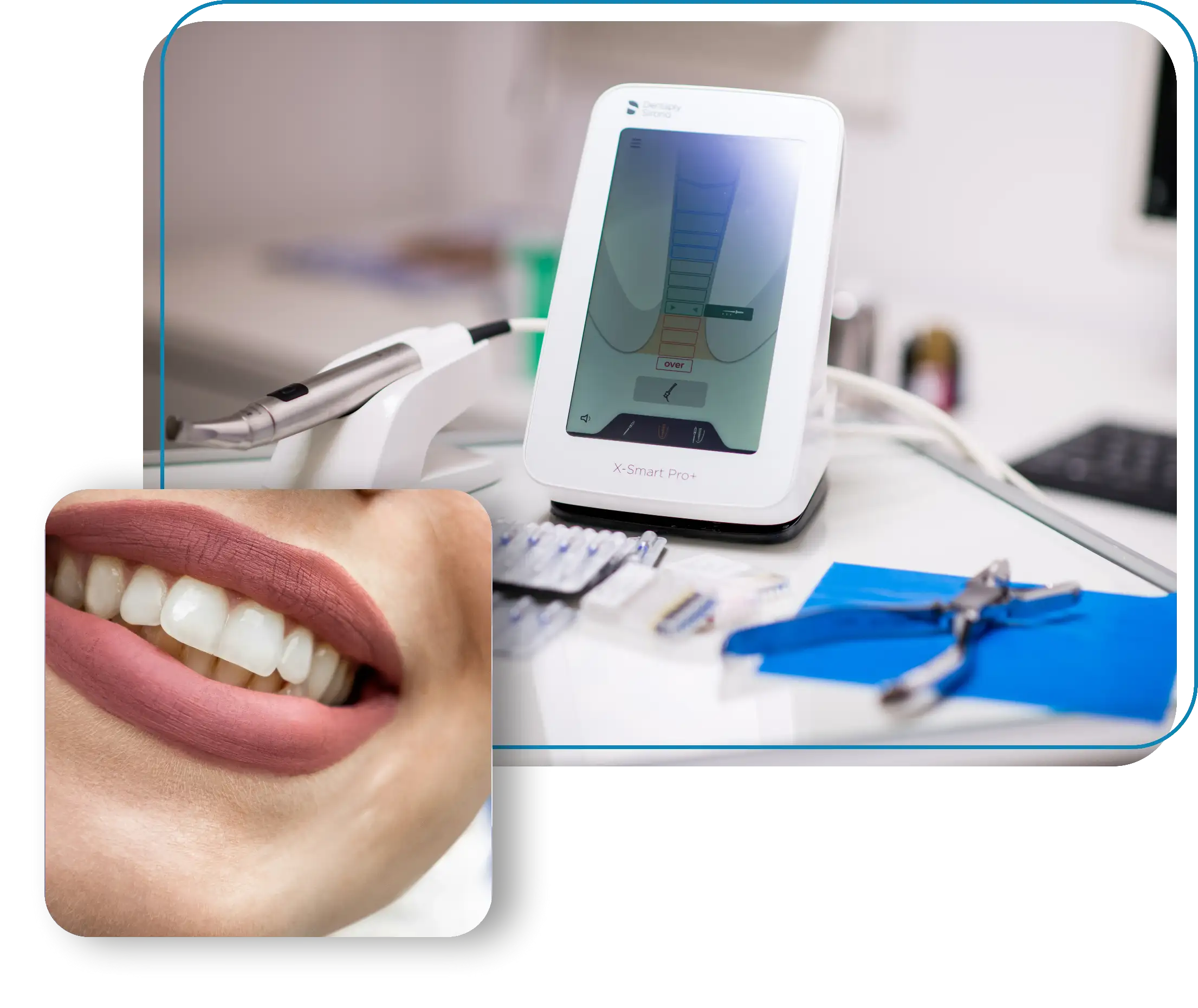
Root canal treatment, also known as endodontic treatment, in many cases makes it possible to save a tooth whose pulp has been irreversibly damaged as a result of deep caries, trauma, a crack, or previous dental procedures.
At Axis Stomatology in Poznań, on Rataje, we perform diagnostics and root canal treatment of single-rooted, two-rooted, and multi-rooted teeth. We also carry out repeat root canal treatment, also known as reendo, as well as additional procedures needed in more complex cases.
The aim of treatment is to remove inflamed or infected pulp, thoroughly clean the root canal system, fill it tightly, and prepare the tooth for durable restoration.

What is endodontics?
Endodontics is a branch of dentistry dealing with the diagnosis and treatment of diseases of the tooth pulp and the tissues surrounding its root.
The pulp is located inside the crown and root canals. It contains, among other things, blood vessels, nerves, and connective tissue. If it becomes irreversibly inflamed or infected, a traditional filling alone may not be enough.
Root canal treatment involves gaining access to the inside of the tooth, removing the diseased pulp, shaping and cleaning the canals, and then filling them tightly. A properly protected and restored tooth can still take part in chewing and retain its place in the dental arch.
Root canal treatment at Axis Stomatology
When is root canal treatment needed?
The need for endodontic treatment is determined by the doctor after an examination and radiological diagnostics. Indications may include, among others:
- irreversible pulpitis,
- pulp infection or necrosis,
- a deep carious lesion reaching into the tooth,
- severe or recurring tooth pain,
- pain persisting after exposure to cold or heat,
- spontaneous pain, especially at night,
- pain when biting or tapping the tooth,
- swelling of the gum or facial tissues,
- a fistula, that is, a small lesion on the gum from which inflammatory discharge may seep,
- an inflammatory lesion around the root apex,
- pulp necrosis after trauma,
- a fracture or crack of the tooth leading to pulp damage,
- the need to retreat previously filled canals,
- preparing selected teeth for specific prosthetic restorations.
Not every toothache means that root canal treatment is necessary. Similar symptoms may result from caries, hypersensitivity, bite overload, gum disease, or problems with an adjacent tooth. That is why, before treatment begins, it is necessary to determine the source of the pain.
DON'T DELETE THIS
Your content goes here. Edit or remove this text inline or in the module Content settings. You can also style every aspect of this content in the module Design settings and even apply custom CSS to this text in the module Advanced settings.
Does every painful tooth require root canal treatment?
No. Pain can have many causes, and some of them can be treated conservatively, without removing the pulp.
If caries has not yet led to irreversible damage to the pulp, it may be enough to clean the cavity, apply proper protection, and place a filling.
The decision to perform root canal treatment is based on the entire clinical picture, not just a single symptom or the X-ray image alone.
Symptoms that should not be ignored
You should particularly make an appointment if you experience:
- intense, throbbing pain,
- pain that wakes you at night,
- long-lasting sensitivity to heat or cold,
- the feeling that one tooth is "higher" than the others,
- pain when touching or biting,
- swelling of the gum, cheek, or area under the jaw,
- the appearance of an abscess or fistula,
- a sudden change in tooth color,
- a fracture or deep crack in the tooth,
- symptoms from a tooth previously treated endodontically.
The absence of pain does not always mean that the pulp and the tissues around the root are healthy. A tooth with a dead pulp may not cause noticeable symptoms for some time, and an inflammatory lesion may only be detected on an X-ray.
Does root canal treatment hurt?
Root canal treatment is usually performed under local anesthesia. As a result, pain during the procedure should be significantly reduced.
In the case of very severe inflammation, achieving full anesthesia may be more difficult. The doctor may then use additional anesthesia methods or divide the treatment into stages.
After the procedure, the tooth may be sensitive when biting for some time. The discomfort should gradually decrease. Its severity depends, among other things, on the previous condition of the tooth and the tissues around the root.
If the pain clearly increases, swelling, fever, or difficulty opening the mouth occurs, contact the office.
Diagnostics before root canal treatment
Accurate diagnostics are the basis for planning treatment. During the visit, the doctor takes a medical history, examines the tooth and the surrounding tissues, and analyzes the nature of the reported symptoms.
Depending on the situation, the following are assessed, among others:
- the tooth's response to stimuli,
- pain when tapping and biting,
- the condition of the existing filling or crown,
- the presence of caries, a crack, or a fracture,
- the condition of the gum in the area of the tooth,
- tooth mobility,
- occlusal conditions,
- the possibility of later durable restoration.
An important element of diagnostics is the X-ray image. It allows the roots, the course of the canals, the condition of the tissues surrounding the tooth, and the presence of inflammatory lesions around the root tips to be assessed.
Images may also be needed during treatment and after it is completed to check the successive stages of the procedure and the quality of the canal filling.
How is root canal treatment performed?
The detailed course of the procedure depends on the tooth's anatomy, the number of canals, the severity of the infection, and previous treatment. Standard treatment includes several basic stages.
DON'T DELETE THIS
Your content goes here. Edit or remove this text inline or in the module Content settings. You can also style every aspect of this content in the module Design settings and even apply custom CSS to this text in the module Advanced settings.
1. Examination and diagnosis
The doctor performs a dental examination, analyzes the X-ray image, and determines whether the tooth qualifies for root canal treatment. The possibility of subsequent restoration is also assessed.
A tooth with a significant root fracture, very extensive tissue loss, or advanced periodontal damage may have a poor prognosis. In such a case, the doctor discusses the possible treatment options with the patient.The doctor performs a dental examination, analyzes the X-ray image, and determines whether the tooth qualifies for root canal treatment. The possibility of subsequent restoration is also assessed.
A tooth with a significant root fracture, very extensive tissue loss, or advanced periodontal damage may have a poor prognosis. In such a case, the doctor discusses the possible treatment options with the patient.
2. Local anesthesia
Root canal treatment is most often performed under local anesthesia. Its purpose is to reduce pain and ensure the most comfortable conditions possible during the procedure.
The patient should inform the doctor about any medications they are taking, chronic illnesses, allergies, and previous reactions to anesthetics.
3. Opening the tooth
The doctor removes caries, a leaky filling, or a fragment of an old restoration, and then prepares access to the pulp chamber and root canals.
If the tooth is significantly damaged, a preliminary restoration of its walls may be necessary before the actual treatment. This helps properly secure the treatment area and allows the next stages to be carried out.
4. Removal of diseased pulp
Pulp affected by inflammation, necrosis, or infection is removed from inside the pulp chamber and canals. In the case of retreatment, it is also necessary to remove materials left in the canals after previous therapy.
5. Shaping and cleaning the canals
The canals are gradually enlarged and shaped using appropriate endodontic instruments. At the same time, they are rinsed with agents that help clean their interior and reduce the number of microorganisms.
The structure of the canal system can be complex. Canals may be narrow, curved, branched, or partially obstructed, which is why the extent and duration of treatment may differ from one tooth to another.
6. Determining the canal length
To properly prepare and fill the root canal, the dentist must determine its length. For this purpose, electronic measurements are used and, if the situation requires it, control X-rays are taken.
7. Intracanal dressing
If treatment cannot be completed during a single visit, a medicinal preparation may be placed in the canals. The tooth is then protected with a tight temporary filling.
An intracanal dressing may be needed, among other things, in cases of extensive infection, exudate from the canal, severe pain, or the need to observe tissue reaction.
The patient should return for the next visit at the time indicated by the dentist. The temporary protection is not the final restoration of the tooth.
8. Canal filling
After thorough preparation, cleaning, and drying, the canals are tightly filled with endodontic material. Its purpose is to seal the prepared space and limit the possibility of microorganisms re-entering.
After the canals are filled, a control X-ray may be taken.
9. Restoration of the tooth crown
Endodontic treatment does not end with filling the canals alone. The tooth must also be restored tightly and permanently.
Depending on the amount of remaining tissue, the following may be used:
- a composite filling,
- a restoration on a glass fiber post,
- a prosthetic restoration,
- a prosthetic crown.
The final method depends on the location of the tooth, the extent of damage, occlusal conditions, and the expected loads.
Treatment of single- and multi-canal teeth
The number of root canals depends on the type of tooth and its individual anatomy. Front teeth usually have a simpler structure than premolars and molars, but there may be various exceptions to this rule.
Single-canal teeth
This group often includes incisors, canines, and some premolars. However, a smaller number of canals does not mean that every case is simple. The canal may be curved, narrowed, or partially obstructed.
Two-canal teeth
Two canals may be found, among others, in premolars and some front and molar teeth. It is necessary to locate, prepare, and tightly fill the entire accessible canal system.
Three-canal and multi-canal teeth
Molars usually have a more complex anatomy. They may have several canals, additional branches, and irregularities. For this reason, their treatment may require more time, several control X-rays, or splitting the procedure into more than one visit.
DONT DELETE THIS
Your content goes here. Edit or remove this text inline or in the module Content settings. You can also style every aspect of this content in the module Design settings and even apply custom CSS to this text in the module Advanced settings.
How many visits does root canal treatment require?
Treatment may be carried out during one visit or divided into several stages. The decision depends, among other things, on:
- the number and anatomy of the canals,
- the degree of infection,
- the presence of exudate or an extensive inflammatory lesion,
- the possibility of thoroughly drying the canals,
- the severity of symptoms,
- the need to use a medicinal dressing,
- previous root canal treatment,
- additional technical difficulties.
After diagnostics, the dentist informs the patient about the planned course of treatment. In more complex cases, the final number of visits may only be determined during treatment.
Emergency relief for tooth pain
Severe pain, pulp inflammation, or swelling may require an emergency procedure. Its purpose is to gain access to the inside of the tooth, reduce pressure and discomfort, and protect the tooth until treatment continues.
During an emergency visit, the dentist may perform, among other things:
- opening the tooth chamber,
- removing part or all of the diseased pulp,
- initial cleaning of the canals,
- applying a medicinal preparation,
- placing a temporary dressing.
An intervention visit usually does not replace full root canal treatment. The patient should continue treatment on the scheduled date, even if the pain subsides after the first procedure.
Repeat root canal treatment - reendo
A tooth previously treated endodontically may, after some time, start causing symptoms again or show changes visible on an X-ray. This does not automatically mean it must be removed.
Repeat root canal treatment may be considered when:
- the canals were not previously filled along their full length,
- part of the canal system was not found,
- re-infection has occurred,
- the old canal filling has lost its seal,
- the tooth crown or filling has become unsealed,
- new decay has appeared,
- an inflammatory lesion at the root persists,
- the tooth hurts when biting, or swelling or a fistula has appeared.
DONT DELETE THIS
Your content goes here. Edit or remove this text inline or in the module Content settings. You can also style every aspect of this content in the module Design settings and even apply custom CSS to this text in the module Advanced settings.
How does reendo work?
During repeat treatment, the dentist gains access to the canals and removes the old material present in them. The canals are then re-examined, prepared, cleaned, and filled.
Reendo may be more complex than the initial treatment. Access to the canals may be hindered by old restorations, root canal posts, narrowing, ledges, blocked fragments of canals, or broken instruments.
Before starting the procedure, the dentist assesses the possibility of performing retreatment and the tooth prognosis.
Removal of a broken instrument from the canal
During previous treatment, a fragment of an endodontic instrument may remain in the canal. Its presence does not always cause pain, but it may hinder access to the further part of the canal and limit the possibility of thorough cleaning.
The decision on how to proceed depends on:
- the location of the fragment,
- the shape and course of the canal,
- the condition of the tissues around the root,
- the presence of infection,
- the possibility of safely removing the instrument,
- the risk of excessive weakening of the root.
In properly qualified cases, an attempt is made to remove the fragment or safely bypass it. Removal is not possible or beneficial for the tooth in every situation, so the decision is made individually.
Restoration of the tooth before and after endodontics
A tooth requiring root canal treatment often has a large cavity, a large filling, or broken walls. Before treatment begins, it may be necessary to rebuild part of the crown in order to properly protect the tooth and allow the subsequent stages to be carried out.
After treatment is completed, it is important to perform a tight final restoration. It protects the inside of the tooth from bacteria re-entering and reduces the risk of fracture in weakened tissues.
The restoration method is selected individually. In teeth with minor tissue loss, a composite filling may be sufficient. In cases of greater damage, the dentist may recommend a glass fiber post or a prosthetic restoration.
The final restoration should not be postponed for too long after root canal treatment is completed.
Recommendations after root canal treatment
After the procedure, follow the dentist's individual recommendations. Usually, it is worth remembering a few rules:
- until the numbness wears off, be careful while eating so you do not bite your cheek, lip, or tongue,
- do not put hard food on the treated tooth if it has a temporary filling,
- do not try to adjust or remove the dressing yourself,
- clean the area of the treated tooth thoroughly but gently,
- take medications only as directed by the dentist or according to the leaflet,
- return for the next visit on the scheduled date,
- have the recommended final restoration made as soon as possible.
If the temporary filling falls out, becomes visibly damaged, or severe symptoms appear, contact the office.
Antibiotics and root canal treatment
An antibiotic does not replace treatment of the cause of the problem located inside the tooth. In the case of an infected pulp, the main approach is usually an appropriate dental procedure, such as cleaning the canals or draining the inflammatory focus.
An antibiotic may be needed in selected situations, especially when the infection spreads, general symptoms occur, or there are additional medical indications. Its use is always decided by a doctor.
You should not take antibiotics left over from earlier treatment or stop the prescribed course without consultation.

Questions and answers
Is a tooth dead after root canal treatment?
During treatment, the pulp is removed from inside the tooth, that is, the tissue containing, among other things, nerves and blood vessels. However, the tooth remains anchored in the bone, is surrounded by living tissues, and can still perform its function.
After treatment, it does not react to cold and heat in the same way as a tooth with living pulp. It may, however, react to pressure, because the tissues surrounding the root remain innervated.
A tooth after root canal treatment requires regular hygiene and check-ups just like the other teeth. It can still develop decay or the restoration can become damaged.
Why is it worth preserving a natural tooth?
Preserving your own tooth helps maintain its natural position in the arch and proper contact with adjacent and opposing teeth.
After successful treatment and proper restoration, the tooth can still:
- participate in chewing,
- transfer chewing forces,
- support bite stability,
- limit the movement of neighboring teeth,
- preserve the natural appearance of the smile.
Not every tooth can be saved, however. The final decision depends on the condition of the root, the amount of preserved tissue, the condition of the periodontium, the presence of cracks, and the possibility of performing a durable restoration.
Does root canal treatment always save a tooth?
Success cannot be guaranteed in every case. The prognosis depends, among other things, on the anatomy of the canals, the degree of infection, the condition of the root, the amount of preserved tissue, and the possibility of performing a tight restoration.
Before treatment, the doctor assesses the condition of the tooth and discusses the expected treatment options with the Patient.
Can a tooth after root canal treatment hurt again?
Temporary sensitivity after the procedure may occur, especially when biting. The tooth may also start causing discomfort after some time, for example as a result of reinfection, a leaky restoration, new decay, or a crack.
Any pain in a tooth previously treated with root canal therapy requires diagnosis.
Is root canal treatment performed under anesthesia?
Most often, yes. The type and method of anesthesia are selected individually depending on the condition of the tooth, the nature of the procedure, and the Patient's health condition.
Is a crown needed after treatment?
Not every tooth requires a crown. The decision depends on its location and the amount of preserved tissue. Back teeth, teeth that are significantly weakened, or those with extensive restorations may require additional prosthetic protection.
Does a dead tooth always hurt?
No. Pulp necrosis can occur without pain. Discomfort may appear only after inflammation develops around the root, or a lesion detected by chance may not cause any symptoms at all.
What does a dressing in a tooth mean?
A dressing is a temporary protection used between stages of treatment. It may contain a medicinal preparation or protect the inside of the tooth from contamination. It should be replaced or removed at the time set by the doctor.
Can you eat after root canal treatment?
After the procedure, it is worth waiting until the anesthesia wears off. If the tooth has been protected with a temporary material, you should avoid biting hard and sticky foods with it until a permanent restoration is made.
What should I do if the dressing falls out?
You should contact the office and schedule an appointment. Leaving the tooth open or not sealed properly may lead to recontamination of the inside of the canals.
Will antibiotics cure a sick tooth?
An antibiotic may reduce some symptoms of a spreading infection, but it usually does not remove its source located inside the canals. Dental treatment or extraction of the tooth may be necessary if it is not suitable to be preserved.
Can a root canal treated tooth break?
Yes. A tooth is often weakened by previous decay, large fillings, or loss of part of the crown. That is why it is important to carry out a properly selected restoration and avoid overloading a tooth that is protected only temporarily.
Root canal treatment in Poznań on Rataje
At Axis Stomatologia, we perform root canal treatment of single-canal, two-canal, and multi-canal teeth, as well as repeat endodontic treatment. We assess each case individually, taking into account the condition of the tooth, anatomical conditions, previous treatment, and the possibility of performing a durable restoration.
Do not put off your appointment if the toothache worsens, persists after contact with hot or cold, appears when biting, or is accompanied by swelling. Early diagnosis can increase the chance of preserving the natural tooth and limit the extent of treatment needed.